


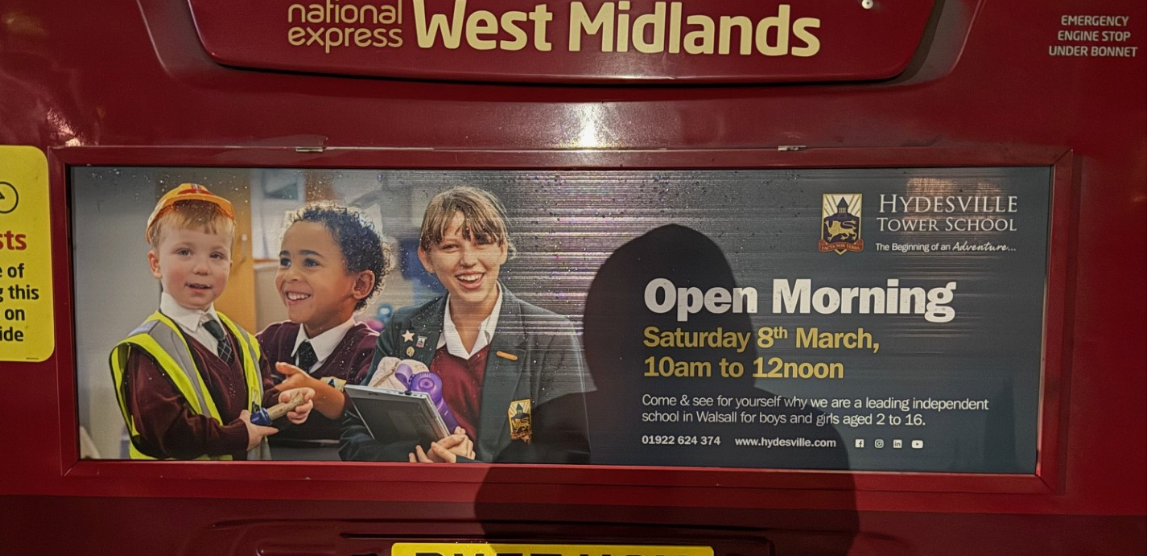







The UK is getting older, and that is changing who marketers need to reach. Silver marketing, the practice of marketing to people aged 50 and over, now covers more than a third of the population and the age groups with the most wealth behind them.
The 50+ audience in numbers
People aged 50 and over in England, 38% of the population.
People aged 85+ projected in the UK by 2049, double the 2024 figure
median wealth of households headed by someone aged 65 to 74
Sources: Centre for Ageing Better, State of Ageing 2025 (ONS data); ONS, National population projections 2024-based; ONS, Household total wealth in Great Britain, April 2020 to March 2022.
How fast is the 50+ audience growing?
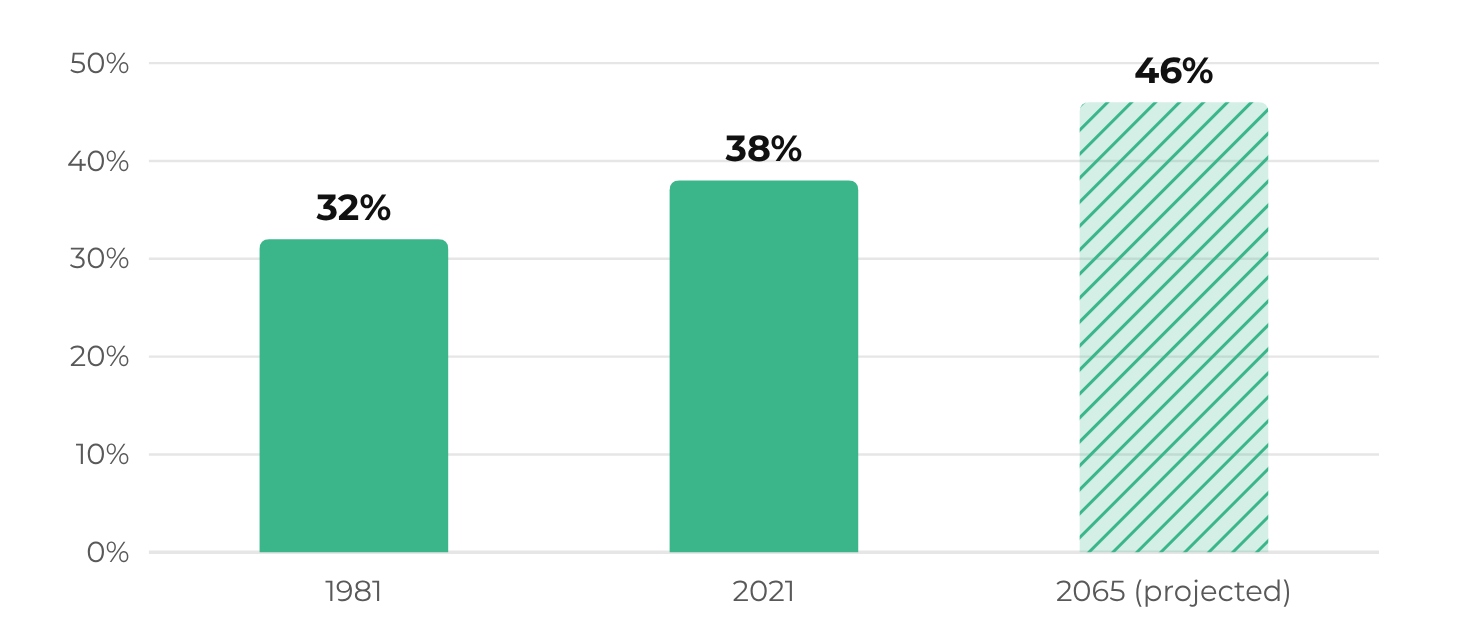
More than 21 million people in England are now aged 50 or over, around 38% of the population. In 1981 this age group made up 32% of the country. Over four decades it has grown by almost 7 million people, a rise of 47%, and projections suggest that by 2065 almost half of England’s population (46%) will be over 50.
The over-50s are becoming a bigger share of the population
Share of England's population aged 50 and over.
Source: Centre for Ageing Better, State of Ageing 2025, using ONS census data (1981 to 2021) and population projections. 2065 is a projection
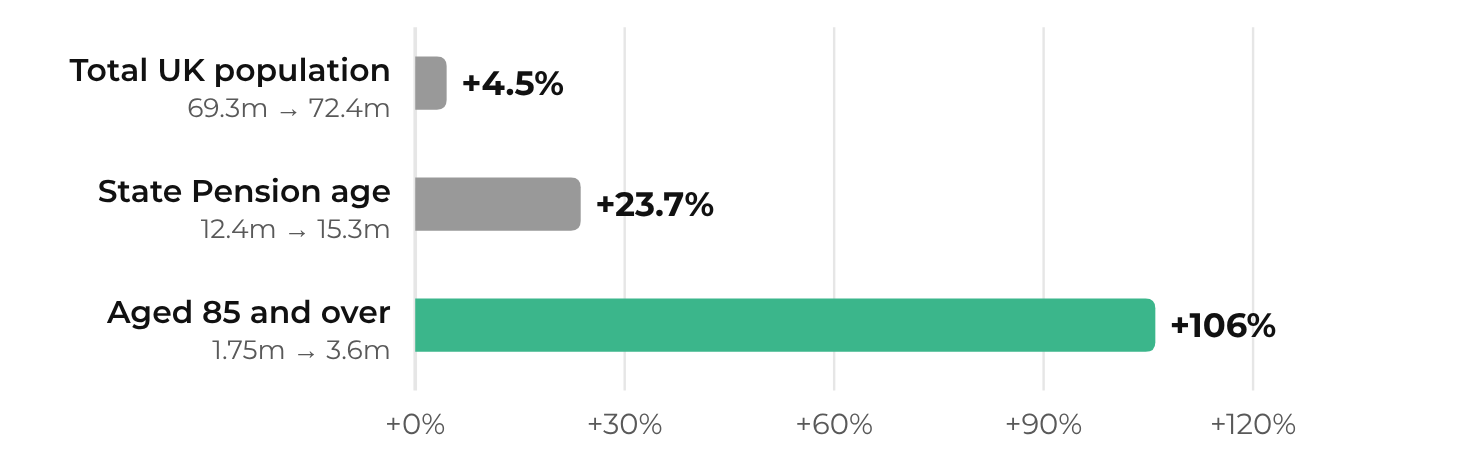
The oldest age groups are growing fastest. ONS projections published in April 2026 show the number of people in the UK aged 85 and over doubling from 1.75 million in mid-2024 to 3.6 million by mid-2049. Over the same period the number of people of State Pension age is projected to rise from 12.4 million to 15.3 million, while the UK population as a whole grows from 69.3 million to 72.4 million.
This audience also holds much of the nation’s wealth. ONS data for April 2020 to March 2022 shows median household wealth rising with age, from £15,200 for households headed by someone aged 16 to 24 to a peak of £502,500 for households headed by someone aged 65 to 74. For brands selling cars, holidays, homes, financial products or home improvements, that spending power is hard to ignore.
Older age groups will grow far faster than the population overall
Projected UK growth, mid-2024 to mid-2049
Source: ONS, National population projections: 2024-based (April 2026). State pension age reflects the planned rise to 67.
People are living longer, so the silver market lasts longer
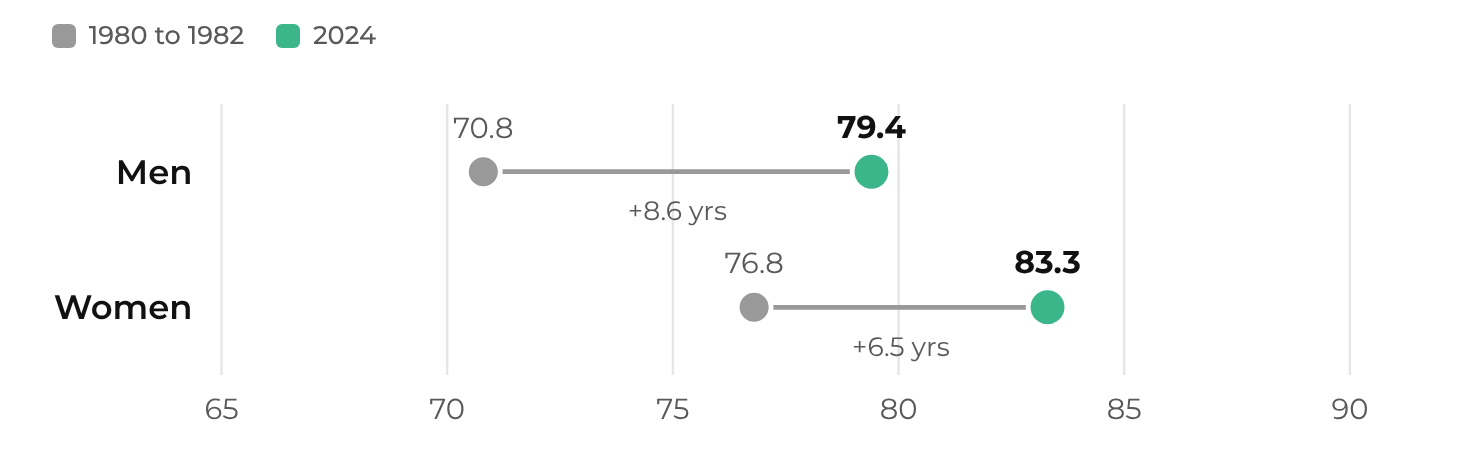
Life expectancy is another reason marketers need to take the over-50s seriously. In the early 1980s, life expectancy at birth in the UK was 70.8 years for men and 76.8 years for women. By 2024 it had reached 79.4 years for men and 83.3 years for women, an increase of more than eight years for men in a little over four decades.
UK life expectancy has risen by six to nine year since the early 1980s
Period life expectancy at birth years.
Source: ONS life table National life tables, UK (1980 to 1982); ONS, Past and projected period and cohort life tables: 2024-based (May 2026)
The ONS life expectancy calculator shows what this means for individuals. A 52-year-old man is expected to live to 83, with a more than 35% chance of reaching 90 and a 4% chance of reaching 100. A 21-year-old woman is expected to live to 89, with almost a 60% chance of reaching 90 and a 14% chance of passing 100.
For marketers, the takeaway is clear. A customer who turns 50 today may have another 30 years or more of buying decisions ahead of them, from cars and holidays to downsizing, retirement planning and technology.
The Chance of Reaching 90 or 100
ONS life expectancy calculator, two example people:
52-year old male
21-year old female
Source: ONS life expectancy calculator (ONS Life expectancy calculator. Figures are averages and do not account for individual health or lifestyle).
Marketing to seniors means understanding more than one generation
The 50+ audience is often treated as one broad demographic. Yet a 55-year-old and an 85-year-old grew up in very different cultural, social and technological worlds, and that shapes how they consume media, discover brands and make purchases.
To understand these audiences, it helps to look at the cultural moments, technology and media that shaped each generation.
Who grew up in each decade and how old are they now
Approximate age in 2026 of someone who spent their childhood and teenage years in each decade
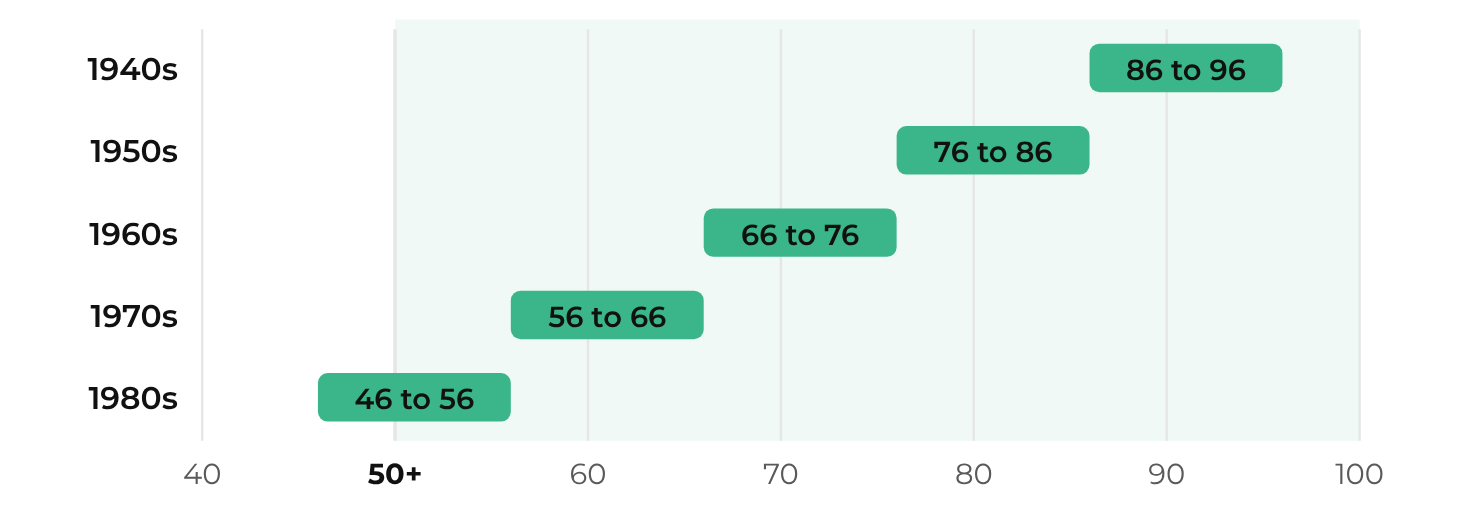
Source: CMe Media analysis. Based on birth years roughly ten years before each decade (for example, born 1940 to 1949 for the 1950s).
The 1940s: radio, cinema and a world at war
Now in their late 80s and 90s. Media of the decade: radio, cinema, comics and print.
For those growing up in the 1940s, everyday life was shaped by the Second World War and its aftermath. Entertainment was largely shared and physical. Radio was central to family life, providing news, music and entertainment, while going to “the pictures” was one of the most popular forms of escapism.
Wartime escapism was also reflected in the Golden Age of Comics, with superheroes such as Superman, Batman and Captain America becoming cultural icons.
Literature reflected the anxieties and changing attitudes of the period. George Orwell published Animal Farm in 1945 and Nineteen Eighty-Four in 1949, while Daphne du Maurier’s Rebecca and Agatha Christie’s detective fiction captured the imagination of readers.
Technology looked very different. Television was still in its infancy, and computers were enormous specialist machines rather than something found in every home. For a generation shaped by war, shared entertainment and a largely pre-digital world, radio, cinema, print and face-to-face experiences formed the foundations of how people connected with the world around them.
The 1950s: the rise of the teenager
Now in their late 70s and 80s. Media of the decade: television, vinyl records and the transistor radio.
The 1950s marked a major cultural shift. As Britain moved away from post-war austerity and rationing, which finally ended in 1954, disposable income increased and a new youth culture began to emerge.
The teenager became an increasingly distinct consumer. Teddy Boys, rock and roll and skiffle reflected a generation developing its own identity, with American culture having a growing influence. Elvis Presley became a global icon as rock and roll took over the charts, while Marilyn Monroe, Audrey Hepburn and Elizabeth Taylor helped define the decade’s changing ideas of youth, beauty and celebrity. James Dean’s image captured a growing sense of teenage independence and resistance to traditional expectations.
Television was becoming increasingly important. ITV launched in 1955, giving British audiences an alternative to the BBC, while the Queen’s Coronation in 1953 helped accelerate television ownership. Vinyl records and portable transistor radios meant music could be taken beyond the family living room, giving teenagers more control over what they listened to.
Even technology began to feel more futuristic. The launch of Sputnik in 1957 captured the public imagination and marked the beginning of the Space Race.
The 1960s: when culture started to change
Now in their late 60s and 70s. Media of the decade: Top of the Pops, the compact cassette and instant cameras.
If the 1950s introduced youth culture, the 1960s amplified it. The Swinging Sixties brought an explosion of music, fashion and social change. The Beatles, the Rolling Stones, The Kinks and The Who helped put Britain at the centre of global popular culture, while Top of the Pops, launched in 1964, turned music into a weekly television event.
London became a global centre of cool. Carnaby Street and the King’s Road became associated with new approaches to fashion, with designers such as Mary Quant helping to popularise the miniskirt.
There was no single “60s look”. Mods embraced tailored suits, scooters, jazz and soul, while Rockers were associated with leather, motorcycles and rock and roll. Towards the end of the decade, hippie and countercultural movements brought psychedelic fashion, experimental music and anti-war politics into the mainstream.
When Bob Dylan went electric
One of the clearest examples of this cultural shift came in 1965, when Bob Dylan performed with an electric backing band at the Newport Folk Festival. Dylan had become closely associated with the acoustic folk movement, so his move towards a louder, electric sound was controversial. It reflected a wider movement towards experimentation, rebellion and new forms of musical expression.
Technology was changing too. Philips introduced the compact cassette in 1963, while Kodak’s Instamatic and Polaroid instant cameras made photography more accessible. Films such as Breakfast at Tiffany’s, Mary Poppins and The Sound of Music became cultural touchstones, before the decade ended with one of the most significant moments of the century: the Moon landing in 1969.
The 1970s: from disco to digital
Now in their late 50s and 60s. Media of the decade: colour TV, home video and the Sony Walkman.
The 1970s brought even more cultural fragmentation. Disco, punk, glam rock, funk and heavy metal all found their audiences, while artists such as David Bowie, Elton John, ABBA, Diana Ross, Stevie Wonder and Fleetwood Mac became major cultural figures. Andy Warhol continued to blur the lines between art, celebrity and popular culture.
Punk changed mainstream ideas about music, fashion and authority. The Sex Pistols and The Clash became associated with the movement, while Vivienne Westwood helped turn punk’s DIY attitude into a distinctive visual language. Fashion was equally expressive, from bell bottoms, platform shoes and oversized sunglasses to afros, shags, mullets and bold makeup.
Jaws, The Godfather, Rocky, Grease and Star Wars helped establish the modern blockbuster, while colour television became increasingly common in British homes.
Technology was also moving into the home. Video games such as Pong introduced a new form of entertainment, home video and VHS began changing how people watched films, and the Sony Walkman, launched in 1979, made personal listening portable. Apple was founded in 1976, with the Apple I and Apple II helping to bring computing closer to the consumer market. The 1970s marked a shift from the analogue world towards the technologies that would shape the decades to come.
The 1980s: video killed the radio star
Now in their late 40s and 50s. Media of the decade: MTV, CDs, VCRs and video games.
The 1980s took the relationship between entertainment, technology and identity even further. In 1981, MTV launched with The Buggles’ Video Killed the Radio Star as its first music video. The title captured a changing media landscape: music was no longer simply something you listened to, it was increasingly something you watched.
Music videos made image, fashion, choreography and celebrity part of the product itself. Michael Jackson, Madonna, Prince and Whitney Houston became global stars, while MTV helped turn musicians into visual icons. Hip hop and rap developed alongside synth-pop, new wave and glam metal, while Live Aid in 1985 demonstrated the enormous cultural power of global music events.
Back to the Future, Ghostbusters, The Breakfast Club, Dirty Dancing and Die Hard became defining films of the decade, while home video gave audiences more control over what and when they watched.
CDs changed the way people listened to music, VCRs and camcorders brought recording into the home, and Nintendo and Super Mario Bros. helped establish video games as mainstream entertainment. Fax machines, pagers, answering machines and the first bulky mobile phones hinted at a more connected future. The decade also had an unmistakable visual identity, from neon and shoulder pads to power suits and bold makeup, with figures such as Princess Diana and Madonna becoming cultural icons.
Where to advertise to seniors
There is no single best place to advertise to seniors, because the 50+ audience spans several generations with different media habits. The decades above give useful starting points for planning and buying media:
- People in their 80s and 90s grew up with radio, cinema and print. Familiar formats, clear messaging and trusted local channels are likely to matter.
- People in their 60s and 70s grew up as television became the main shared medium, so TV, video and brand recognition built over time carry weight.
- People in their 50s grew up with MTV, home computers and video games, and many are as comfortable with search, social media and online video as younger buyers, which makes paid search and social advertising a natural fit.
These are starting points rather than rules. Effective advertising to senior citizens comes from testing channels and messages against real audience data rather than assumptions about age.
More than a demographic
Looking across these decades makes one thing clear: the silver market is not one audience. Someone in their 50s may have grown up with MTV, cassette tapes and video games. Someone in their 80s may have grown up with radio, cinema and post-war Britain. Their expectations of brands, customer service, technology and media can be very different. For many, decades of familiarity also translate into strong brand loyalty, which makes this an audience too valuable to overlook.
Understanding these differences means looking beyond age alone. What shaped their relationship with media? Which brands have they trusted? How do they prefer to discover, research and buy?
At CMe Media, we believe effective digital marketing starts with understanding the people behind the numbers. Age is useful data, but it isn’t the whole strategy.
The question isn't just "How old are they?" It's "What shaped them?"
Planning a campaign for the 50+ market? Contact the CMe Media team to talk through your audience, channels and content plan.
Frequently asked questions
What is silver marketing?
Silver marketing is marketing aimed at older consumers, usually people aged 50 and over. It covers how brands research, message and reach this audience across traditional and digital channels.
What age group does the silver market cover?
Why should marketers target the over-50s?
How do you advertise to senior citizens effectively?
Sources
- Centre for Ageing Better: Our ageing population, State of Ageing 2025
- ONS: National population projections, 2024-based
- ONS: Household total wealth in Great Britain, April 2020 to March 2022
- ONS: Past and projected period and cohort life tables, 2024-based
- ONS: Life expectancy calculator
- Silver Marketing Association
- The Herbert: Grown up in the 1940s
- The Herbert: Grown up in the 1950s
- The Herbert: Grown up in the 1960s
- The Herbert: Grown up in the 1970s
- BBC Bitesize
- Capture: What was popular in the 1960s